
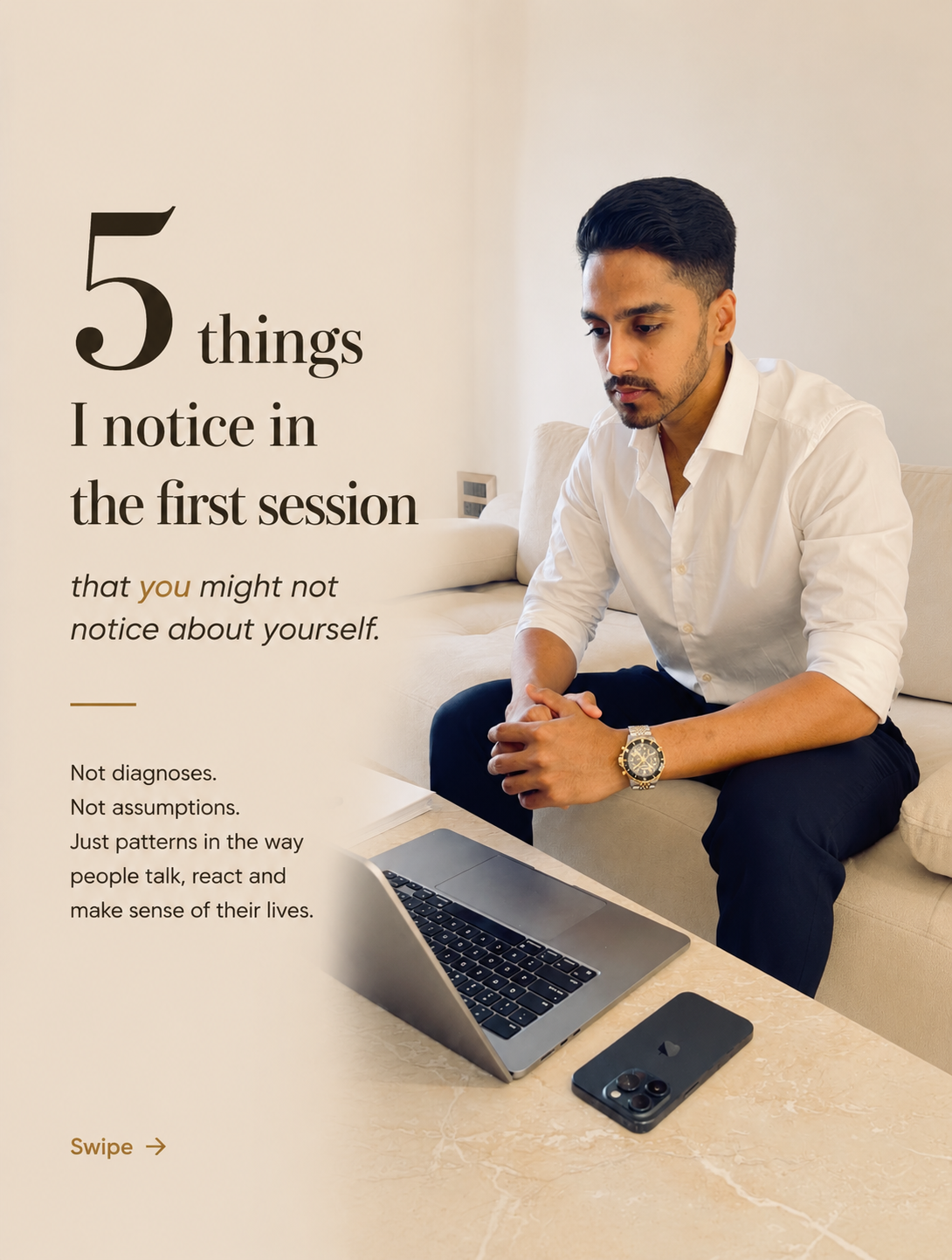
5 Psychological Patterns I See in Nearly Every First Session
There is a moment that happens surprisingly often in a first session.
Someone has spent the first ten or fifteen minutes explaining what brought them in. They have given me the timeline, the context, the people involved and, usually, a fairly convincing explanation for why they shouldn't be struggling as much as they are.
Then they say something like: "Sorry, this is probably stupid." Or: "I'm probably just being dramatic." Or: "Honestly, I'm fine."
Sometimes they mean it. Sometimes they don't. And that distinction is part of what makes a first session psychologically interesting.
A first session isn't simply a list of symptoms, events and problems. It is also an opportunity to understand how someone makes sense of those experiences, what they emphasize, what they minimize, where they hesitate, and how they position themselves in relation to what has happened.
The following are not diagnostic signs. They are patterns I notice and then become curious about.
1. You apologize before you've even said the thing
"Sorry, this is probably stupid…" "Sorry, I know I'm overreacting…" "I shouldn't really be talking about this…"
The apology sometimes arrives before the vulnerability. Psychologically, that can function as a form of self-protection: if I criticize myself first, perhaps you won't have the opportunity to judge me.
For some people, this fits into a broader pattern of self-criticism and concerns about how they will be received by others. Research on adult attachment has found meaningful associations between attachment insecurity and self-criticism, including feelings of inadequacy, a general pattern found across groups in research, not something readable off one person's apology in a single session.
That does not mean an apology tells me someone's attachment style. It means I might wonder: "What do you expect will happen if you take up emotional space without apologizing for it?"
Sometimes the more important information isn't what someone is apologizing for. It's why they believe they need permission to say it.
2. You call it "dramatic" before anyone else can
"I'm probably just being dramatic." "It's honestly not that big a deal." "I know this sounds stupid."
There is a difference between putting something into perspective and invalidating your own emotional experience. When someone repeatedly minimizes their own reactions, I become curious about where that habit came from.
Some people learned, explicitly or implicitly, that certain emotions were inconvenient, excessive or unacceptable. Over time, they may begin doing the invalidating themselves before anybody else gets the chance. Research on self-invalidation shows that people can negatively evaluate their own emotional experiences, and that this process is associated with difficulties in emotion regulation.
So rather than immediately asking, "Is this reaction disproportionate?" I may first ask: "Why did you decide your reaction wasn't allowed to matter?" That is a very different question.
3. "I'm fine" can mean several very different things
"I'm fine." Three words. At least three possibilities.
Sometimes someone genuinely is fine. Sometimes they know something is wrong but don't know how to explain it. And sometimes they know exactly what they are feeling but aren't ready to go there.
This is where emotional awareness becomes clinically relevant. Alexithymia refers to difficulties identifying and describing one's own feelings, alongside a tendency toward externally oriented thinking. It is not synonymous with being emotionally detached, and saying "I'm fine" certainly does not establish alexithymia.
But when someone's emotional vocabulary repeatedly becomes vague "fine," "stressed," "nothing," "just tired" I may become curious about the person's access to their internal experience. Sometimes the first therapeutic task isn't solving the problem. It's helping someone find the words for what the problem actually feels like.
4. "We have a communication problem" isn't always about communication
This is particularly common in relationship work. A couple may arrive saying: "We just don't communicate properly." But underneath the argument, there may be sentences that sound more like: "I expected you to know." "I thought you would understand." "I shouldn't have to ask."
Now we're dealing with something slightly different. The problem may not simply be a failure to communicate information. It may be a gap between an internal expectation and what the other person actually knows or does. Research on relational expectations has found that discrepancies between what people expect from their partners and what they perceive their partners actually do are associated with relationship satisfaction.
This is why sometimes improving communication isn't just about teaching couples to speak more clearly. It is about making the unspoken expectation speakable: "I wanted you to notice without me asking." "I wanted you to understand why this mattered." "I wanted you to know what I needed." Once that expectation is visible, the couple finally has something they can actually work with.
5. The thing you're most ashamed of isn't always the thing that needs fixing
This may be one of the most important distinctions in psychological work. Someone can spend an entire session telling me about the behaviour they are ashamed of. But underneath the behaviour may be a much deeper belief: "I'm too much." "I'm not enough." "There's something wrong with me."
Shame is fundamentally different from simply thinking "I did something I regret." It can involve a much more global negative evaluation of the self. And that distinction matters. Because if the central problem is "I made a mistake," we may need to work with the behaviour. But if the conclusion has become "I am the kind of person who is fundamentally wrong," then fixing the behaviour alone may never feel like enough.
A recent meta-analysis supports a relationship between insecure attachment and shame, although the relationship is complex and shouldn't be inferred diagnostically from an isolated observation.
So I pay less attention to the shameful story itself and more attention to the belief underneath the shame.
What if you recognized yourself?
First: don't diagnose yourself from an Instagram carousel, or from a blog post. Recognizing a pattern doesn't mean you have a disorder, an attachment style, alexithymia or some hidden psychological problem. It simply gives you a question worth exploring.
You might start by noticing: What do I apologize for? What do I automatically minimize? What do I mean when I say "I'm fine"? What do I expect people to understand without me saying it? And what do I believe about myself when something goes wrong?
These questions can sometimes tell you more than another personality quiz ever will. Because good psychological work isn't about finding a label as quickly as possible. It's about understanding the pattern well enough to know what to do with it.
If something in this post felt uncomfortably familiar, you don't necessarily need to figure it all out by yourself. Therapy can be a place to slow those patterns down, understand where they came from, and work out what you want to do differently.
If you'd like to explore that, you can book a consultation. (https://www.health-healinghour.com/mr_abhishek_faria)